

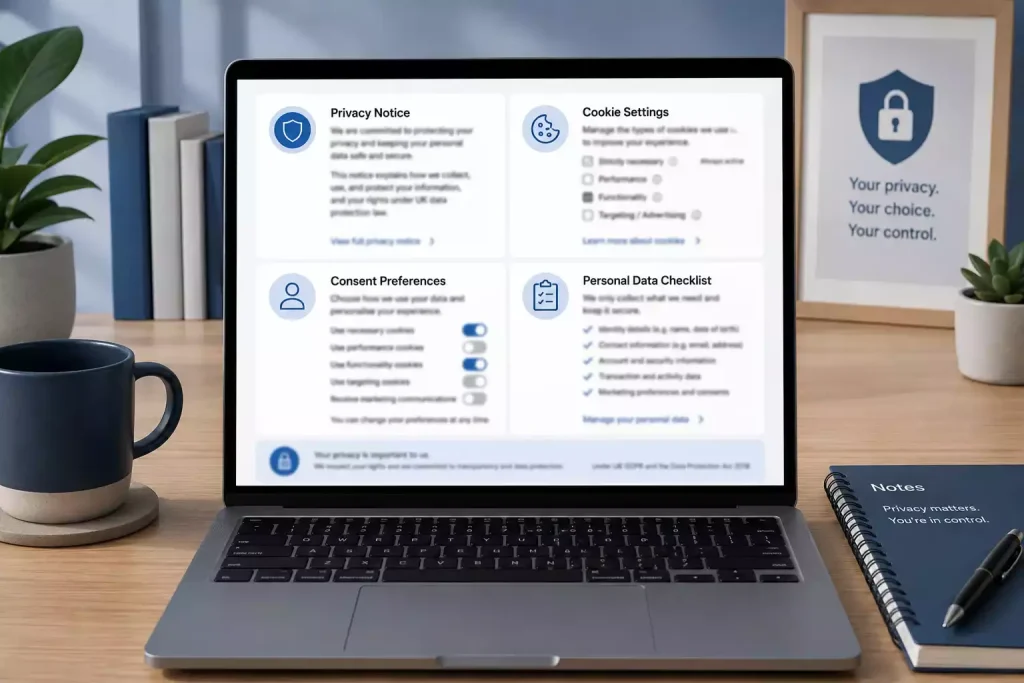
Opening a gambling account is not only a money decision. It is also a data decision. A site may ask for your name, address, date of birth, identity documents, payment information and communication preferences. It may also use cookies, marketing tools, profiling or automated decisions. Before you create an account, the useful question is not only “can I deposit?” It is “do I understand what will happen to my personal data?”
This guide explains the privacy checks that matter before account creation. It does not decide whether a specific site is lawful or unlawful. It does not promote anonymous play or no-verification accounts. It gives a practical way to read privacy information, connect it to licence checks, and avoid handing over personal details when basic explanations are missing.
The wider context is on our guide to the phrase and the checks.
Why privacy matters in a gambling account
A gambling account can involve sensitive patterns: how often you play, when you deposit, how much you spend, whether you use limits, how you respond to offers and whether your behaviour suggests risk. Even where a business has a legitimate reason to collect some information, you should still be able to understand the basics before you sign up.
The Information Commissioner’s Office explains that privacy information should help people understand why data is used, what data is used, how long it is kept, who it is shared with, whether it is transferred overseas, what rights a person has, where data came from, whether profiling or automated decisions are involved, who to contact and how to complain to the ICO, unless an exception applies. That is a long list, but it has a simple purpose: a person should not be kept in the dark about data use.
For gambling, this matters even more when a site is described as outside GAMSTOP or appears to operate from another jurisdiction. Before you share identity documents or payment details, check the business through official gambling records and read the privacy information as a separate issue. A gambling licence check and a privacy check answer different questions, and both can matter.
Privacy notice questions before account creation
A privacy notice does not need to be exciting, but it should be understandable. If it is vague, hidden, broken, contradictory or written only in slogans, that is a warning sign. Use the checklist below before you create an account or upload documents.
| Question to ask | Why it matters | Warning sign |
|---|---|---|
| Why is my data collected? | You should understand whether the purpose is account administration, identity checking, payment handling, safer gambling, marketing or another stated use. | The notice says data is used for “services” but never explains the actual purposes. |
| What data is collected? | Account data, identity data, payment data, device data and communication data can have different risks. | The sign-up asks for sensitive details that are not mentioned in the privacy information. |
| Who is data shared with? | Verification providers, payment providers, group companies and regulators may be described differently. | The notice uses broad wording such as “partners” without meaningful explanation. |
| How long is data kept? | Retention periods help you understand whether data is kept only as needed or for longer stated purposes. | No retention explanation appears, or the wording is too broad to be useful. |
| Are there overseas transfers? | Some businesses or service providers may process data outside the UK. | The notice mentions global transfers but gives no clear safeguards or route to more information. |
| Is profiling or automated decision-making used? | Automated decisions may affect account access, marketing, risk checks or other account actions. | The site refers to personalisation or risk scoring but does not explain whether automated decisions are involved. |
| How can I use my rights? | ICO public guidance covers rights such as access to personal data and information about decisions made without human involvement. | There is no clear contact route for data rights or complaint escalation. |
Cookies and marketing are not minor details
Cookies and marketing tools can shape what you see before and after you create an account. They may support analytics, advertising, personalisation or account functions. In a gambling setting, that can matter because marketing pressure may encourage someone to return after they were trying to stop, reduce play or avoid gambling altogether.
Do not treat cookie banners as harmless decoration. Read what is optional, what is necessary, and what happens if you reject non-essential tracking. If the banner is confusing or the privacy information does not explain marketing use clearly, pause before creating an account. The ICO has taken action against a gambling brand over cookies without consent; that does not prove every gambling site has the same problem, but it does show that gambling-related cookie practices can attract regulatory scrutiny.
Advertising rules also matter. ASA and CAP gambling advertising rules set social-responsibility boundaries for gambling ads and marketing claims. For a reader, the practical point is to be cautious with ads that make gambling sound low-risk, urgent, inevitable or socially necessary. A promotional message is not a personal safety check.
Data checks and account verification are connected
Identity checks can be legitimate, but they still involve personal data. If a business asks for proof of age, identity, address or payment ownership, the privacy notice should help you understand why that information is needed, how it may be used, who may see it and how long it may be kept. A request for documents without clear privacy information deserves caution.
That does not mean the safe answer is to avoid checks or look for no-verification play. For GB-licensed online gambling businesses, age and identity checks are part of the protection framework. The problem is not that verification exists. The problem is when a person is asked to trust a site without clear business identity, clear licence information, clear terms and clear privacy explanations.
If your concern is mainly a delayed withdrawal or a document request after account use, read the verification, withdrawals and complaints guide. That page deals with the account-dispute route. This page is about privacy understanding before and around account creation.
A safer decision path
Use this simple path before giving a gambling site personal data. It is deliberately slower than a sign-up page because speed is rarely your friend when money and identity documents are involved.
- Check the gambling business first. Use the licence and register checking guide to compare the business name, domain and stated licence information with official records.
- Read the privacy notice before creating the account. Look for purposes, data types, sharing, retention, overseas transfers, profiling, automated decisions, rights and complaint routes.
- Check marketing settings. Decide whether emails, texts, calls, push messages, profiling or personalised offers are acceptable to you. If you are trying to reduce gambling, the safer answer may be no.
- Look at cookies before browsing further. Rejecting optional tracking should not require a confusing process. If the banner is difficult to understand, treat that as part of your trust assessment.
- Stop if the explanation is missing. Do not upload identity documents, payment details or proof of address just because the site is convenient or promises quick access.
Before any of this matters, verify the business itself: how to check a licence.
If marketing pressure is part of the problem
Privacy and marketing questions can become personal very quickly. If you are receiving gambling messages after trying to stop, or if promotional offers make it harder to stay away, treat that as a protection issue as well as a data issue. Change marketing preferences where possible, keep evidence of unwanted messages, and use data-rights routes when appropriate.
If the pressure connects to self-exclusion, loss of control or distress, the self-exclusion and support guide gives a support-first route. It is not necessary to wait until a privacy complaint is finished before adding practical friction to gambling access.