

If you have joined GAMSTOP, used another self-exclusion route, or feel pulled toward gambling again, a page about sites outside GAMSTOP can become risky very quickly. The safer question is not “where else can I play?” The safer question is “what can I do in the next few minutes to protect myself?”
This guide is support-first. It does not list casinos, describe ways around self-exclusion, explain how to bypass identity checks, or suggest alternative access routes. It focuses on the moment when the urge to gamble is active, and on practical steps that add distance, support and friction.
The wider context is on our guide to the phrase and the checks.
Start with the boundary
GAMSTOP is a self-exclusion protection mechanism for online gambling. GB-licensed online gambling businesses must participate in GAMSTOP, and GAMSTOP covers gambling websites and apps run by businesses licensed in Great Britain. If a site is promoted as outside GAMSTOP, that is not a helpful feature for someone who is trying to stay away from gambling. It is a warning sign that the protection boundary is being tested.
GAMSTOP’s own terms include a commitment not to try to get around GAMSTOP mechanisms during the self-exclusion period. That is why this page does not explain workarounds. Looking for a route around a block can keep the urge alive, lengthen the moment of risk and make it harder to pause. The immediate goal is to interrupt the chain: device, payment method, gambling site, deposit, regret.
This is not about shame. Many people feel a strong urge after putting a barrier in place. A barrier does not remove every feeling; it creates a gap between the feeling and the action. The most useful response is to widen that gap.
What to do depending on the situation
| Situation | Safer next step | Why it helps |
|---|---|---|
| I am on GAMSTOP and want to gamble today. | Stop looking for gambling sites, move away from the device, tell one trusted person what is happening, and use a support route before the urge is acted on. | It turns the moment from private pressure into a supported pause. |
| I am not on GAMSTOP, but gambling feels hard to control. | Consider self-exclusion and add practical friction such as bank gambling blocks and spending limits where available. | Control tools work best before another deposit happens. |
| I am worried about debt, panic or urgent distress. | Contact an appropriate support service immediately. GamCare and NHS gambling support can help with gambling problems, while Samaritans can be used for urgent emotional distress. | Financial panic and emotional distress need support, not another account decision. |
| I need extra friction on payments or access. | Use bank gambling blocks where available, review financial limits and reduce easy access to gambling-related payments. | Extra steps can slow the action long enough for the urge to pass. |
| I am being targeted by marketing after trying to stop. | Change marketing preferences, keep evidence of unwanted messages, and read the privacy and data guide for rights and complaint routes. | Marketing pressure can undermine a decision to stop, so it should be treated as part of the protection picture. |
A ten-minute pause plan
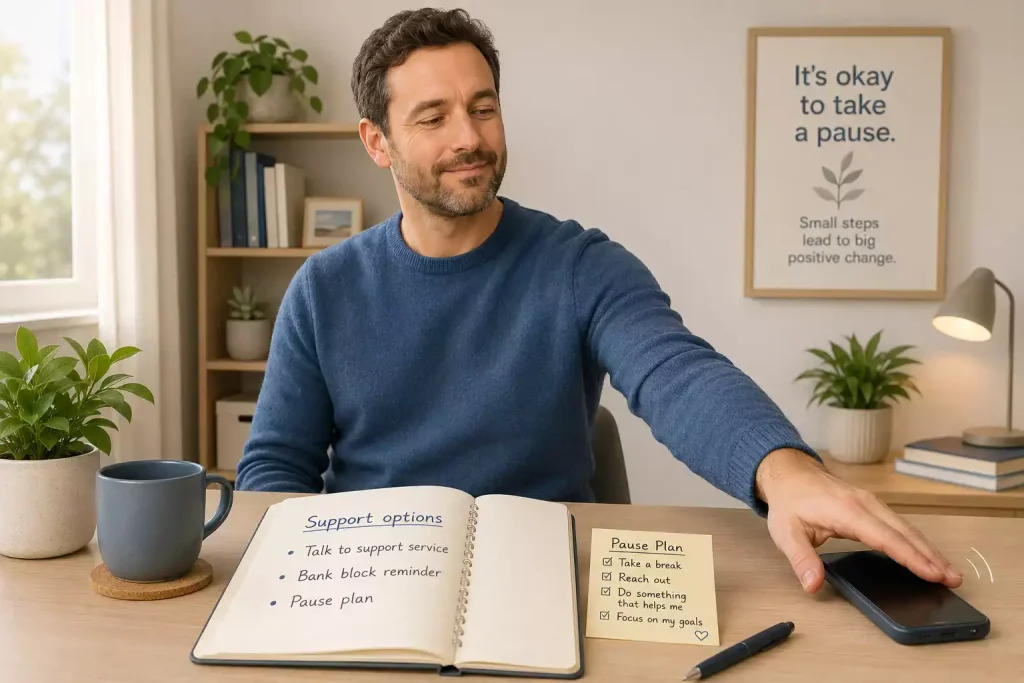
An urge can feel permanent while it is happening, but the first practical goal is small: get through the next ten minutes without depositing, registering or trying another route. The plan below is simple because complicated advice is hard to follow under pressure.
- Put the device down or change rooms. Break the physical pattern of scrolling, clicking or comparing sites. If possible, leave the room where the urge started.
- Remove the payment trigger. Do not test whether a card, wallet or transfer route works. Put payment details out of reach and avoid checking balances in a way that feeds the urge to gamble.
- Say the situation out loud. A plain sentence helps: “I am tempted to gamble even though I put a block in place.” This turns a hidden impulse into something you can respond to.
- Contact support or a trusted person. Use GamCare, NHS gambling support or Samaritans where the situation fits, or contact someone you trust who knows you are trying to stop.
- Add one barrier before returning to the device. That might be a bank gambling block, a spending-limit review, a blocking tool or removing saved payment details. Do not wait until motivation feels perfect.
This pause plan is not treatment and it is not a guarantee. It is a practical interruption. If you are in immediate danger or feel unable to stay safe, seek urgent local help now.
Bank gambling blocks and extra friction
Bank gambling blocks can add friction by blocking transactions categorised as gambling. GamCare describes these as free tools offered by most UK banks. This page does not make bank-by-bank claims, because features, delays and settings can differ. The practical step is to check your own bank’s current options and turn on the strongest gambling block available to you.
A block is not a moral judgment. It is a design choice that makes the risky action harder. It may be especially useful when a person has moments of pressure rather than a constant urge. The block creates a gap between wanting to gamble and being able to move money quickly.
Extra friction can also include account limits, self-exclusion, blocking tools, removing saved payment details, unsubscribing from gambling marketing and asking someone trusted to help with access to money during high-risk periods. Keep the list practical and realistic. A barrier you actually use is better than a perfect plan that stays in your head.
When “not on GAMSTOP” appears in front of you
If the phrase appears in an advert, message, review or website heading while you are self-excluded, treat it as a prompt to leave, not a prompt to compare options. The absence of GAMSTOP is not a consumer benefit for someone who has chosen self-exclusion. It means the protection you set up may not apply in the way you need it to apply.
The meaning and boundary guide explains why the phrase should be handled carefully in Great Britain. The licence and register checking guideexplains official checks for gambling businesses. But if your immediate issue is an urge to gamble after self-exclusion, do not use checking steps as a reason to stay engaged with gambling sites. Use support first.
Understanding the phrase itself helps: what “not on GAMSTOP” means.
Marketing, data and pressure
Marketing can be a powerful trigger after someone has tried to stop. Messages about offers, reminders, account status or “limited time” promotions can make gambling feel urgent. If those messages are part of the problem, treat them as evidence of pressure, not as something you have to answer.
The data, privacy and marketing guide explains how to look at privacy notices, marketing preferences, cookies and data rights. Use those routes when you need them, but keep the immediate focus simple: reduce exposure to gambling prompts, keep records of unwanted messages, and use support if the messages are making it harder to stay away.
Helpful wording for a support message
When pressure is high, writing a message can feel harder than acting on the urge. Use plain wording. You do not need to explain everything at once.
I am trying not to gamble, but I am tempted right now. I have been looking at gambling sites and I need help pausing before I do anything with money. Can you stay with me, message me back, or help me use a support service?
That message is enough. It tells someone what is happening, what the risk is and what help you need. If a trusted person is not available, use a support route directly. You do not have to wait until the situation becomes worse.