

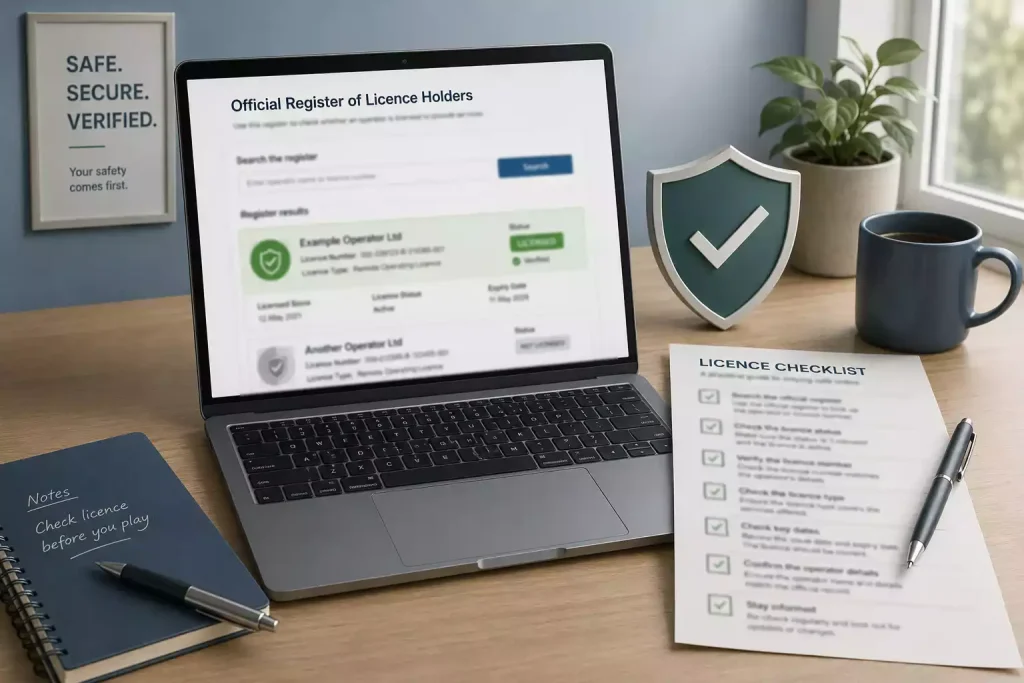
Before transferring money to an online gambling business, the safest starting point is not a review, a bonus claim or a badge in a website footer. It is an official check. For consumers in Great Britain, the Gambling Commission’s Public Register is the place to compare licence information, domain details and business identity against what a gambling site says about itself.
This guide focuses on checks that can be done before money or personal data is handed over. It does not recommend operators, score sites or suggest that a checked business is risk-free. A check can expose warning signs, but it is not a green light to gamble, and it does not replace support if you are trying to avoid gambling after self-exclusion.
The wider context is on our guide to the phrase and the checks.
Start with the official register, not the marketing page
A gambling website may display a licence number, a company name, a seal or a statement about regulation. Those details are only useful if they match an official record. The Gambling Commission says licensed businesses must display licensing information and link to the Public Register. The register lets consumers see information such as permitted activities and whether regulatory action is listed.
The practical check is simple in principle: take the business name, trading name, account number or domain shown on the site and compare it with the register entry. Do not assume that a similar name is enough. Do not assume that a licence for one domain covers another domain. Do not assume that a copied footer, old screenshot or third-party article proves current permission.
If a site is promoted as a casino outside GAMSTOP, this check becomes even more important. GB-licensed online gambling businesses must participate in GAMSTOP. A site that appears outside that scheme should make you ask whether it is actually licensed for Great Britain, whether the domain matches the claimed business and whether the protections you expect are present.
Pre-deposit check table
| What to check | Where to check it | What a warning sign looks like | What not to assume |
|---|---|---|---|
| Official register match | The Gambling Commission Public Register, using the business name, trading name, domain or account number. | The name is missing, the domain is not listed, or the licence details do not match what the site claims. | Do not assume a logo or footer statement is equal to a current official record. |
| Domain and trading name | The register entry and the site’s own account-opening information. | A site uses a different brand, domain or company from the register entry without clear explanation. | Do not assume one licensed brand automatically covers every related-looking website. |
| Licence status | The current status shown by the official register. | The status is unclear, suspended, expired, limited or absent. | Do not assume a past licence, foreign licence or copied number gives current GB permission. |
| Terms and bonus restrictions | The site’s account-opening information, promotion terms and main terms and conditions. | Important conditions are hard to find, vague, surprising or only shown after registration. | Do not assume a free offer is simple because the headline looks generous. |
| Fees | The account-opening information and payment or withdrawal terms. | Charges are unclear, scattered across pages or not explained before deposit. | Do not assume deposits, withdrawals or inactivity are free unless the terms say so clearly. |
| Customer-funds protection level | The account information that explains how customer money is protected if the business fails. | The protection statement is missing, vague or difficult to understand. | Do not assume gambling balances are protected like personal bank accounts. |
| Complaints and ADR information | The complaints section, terms and official information linked by the business. | The route is unclear, hidden or inconsistent with the licence information. | Do not assume a dispute will be solved quickly just because support chat is available. |
Read account-opening information before registration
The Gambling Commission identifies account-opening information as an important consumer-protection area. Before opening an account, a reader should be able to understand the licensed status of the business, account fees, how customer money is protected, free offers and bonuses, and the terms and conditions that govern play, withdrawals and promotions.
This matters because gambling offers often look simple at the headline level. A free-spin, bonus or matched-deposit claim may have conditions that affect withdrawals, eligibility or account decisions. The correct response is not to hunt for a better offer. It is to read the conditions before depositing and to avoid any offer whose rules are unclear or surprising.
Fair and transparent terms are not just a comfort issue. The Gambling Commission and the Competition and Markets Authority have both focused on bonus promotions and withdrawal obstacles in the gambling sector. That does not mean every individual complaint will have the same outcome, but it does show why terms and withdrawal rules need attention before a deposit is made.
Separate evidence from signals that only look official
Some signals feel reassuring but are weak on their own. A professional-looking website, fast live chat, a long legal footer or a familiar payment logo does not prove that a gambling business is licensed for Great Britain. A review site or forum post may be out of date, incomplete or commercially motivated. A copied licence number may belong to a different business or domain.
Stronger evidence is specific and checkable. The business name should match. The domain should match. The current licence status should make sense. The permitted activities should fit what the site offers. The account-opening information should be available before payment. The customer-funds statement should be clear enough for an ordinary reader to understand the level of protection being claimed.
Even when those items are present, the check is still only one part of a wider decision. It does not remove the risk of losing money, developing harmful gambling patterns or struggling to withdraw if documents, terms or account activity become disputed.
What to do with the result of your check
If the official details do not match the website, do not deposit. If the licence position is unclear, do not treat the uncertainty as a minor inconvenience. If the terms hide important restrictions or the customer-funds statement is hard to find, that is also a reason to stop and reconsider.
If the official details do match, continue with caution rather than confidence. Read the payment and withdrawal rules. Check whether the business explains identity checks and complaints. Look at customer-funds protection. Think about whether you are gambling for entertainment with money you can afford to lose, or whether you are trying to recover losses, bypass limits or gamble after self-exclusion.
The next checks depend on the concern. For the meaning of “outside GAMSTOP”, use the plain-language boundary guide. For money controls and customer-funds risk, use the payments and limits guide. For document requests, delayed withdrawals or complaints, use the verification, withdrawals and complaints guide. For privacy notices, marketing and data sharing, use the data and marketing checks guide.
Money questions come next: payments, limits and customer funds.