

The phrase “casino not on GAMSTOP” usually describes an online gambling site that is not part of the GAMSTOP self-exclusion scheme. For a reader in Great Britain, that is not a small technical detail. It is a signal to slow down, check the licensing position and think carefully about why the site is outside a protection system that GB-licensed online gambling businesses must take part in.
This guide explains the phrase without listing casinos, ranking sites or treating the absence of GAMSTOP as a benefit. The useful question is not “which site is outside GAMSTOP?” The useful question is “what protection, licence and personal-risk issues does this wording raise?”
The full picture is on our guide to the phrase and the checks.
The plain meaning
GAMSTOP is the national online self-exclusion scheme used by gambling businesses licensed in Great Britain. When someone self-excludes through GAMSTOP, the scheme is meant to block access to online gambling websites and apps run by those GB-licensed businesses for the chosen exclusion period. That is why the wording “not on GAMSTOP” matters: it points to a site that is not covered by that specific GB scheme.
That does not automatically tell you everything about the site. It does not prove that the business is safe. It does not prove that the business is licensed for Great Britain. It does not prove that the site can lawfully serve a person in Great Britain. It also does not mean that the site has stronger consumer protection. The phrase only tells you that the site is being presented as outside the GAMSTOP net, and that is a reason to check more carefully, not a reason to assume comfort.
For legal precision, it is better to talk about Great Britain rather than the whole UK. The Gambling Commission regulates commercial gambling and remote gambling offered to consumers in Great Britain. A licence from another country does not by itself allow an online gambling business to provide gambling to consumers in Great Britain unless the business has the required Gambling Commission licence or an exemption.
Why the absence of GAMSTOP is not a consumer benefit
A site that is outside GAMSTOP may be described in marketing as flexible, unrestricted or open to excluded players. Those are the kinds of words that should make a cautious reader pause. If the reader has joined GAMSTOP, the point of the scheme is to create distance from online gambling. Looking for a place outside it can pull the person back toward the behaviour the exclusion was meant to interrupt.
Even for a reader who is not self-excluded, the absence of GAMSTOP should not be treated as a positive feature. GB-licensed online gambling businesses must participate in GAMSTOP. If a gambling site appears to serve people in Great Britain while presenting itself as outside GAMSTOP, the first practical issue is the licensing and protection boundary. What licence does the business claim to hold? Does that licence match the domain being used? Is the business on the Gambling Commission’s Public Register? Are the terms, customer-funds statement and complaint route easy to find before any money is sent?
None of those checks turns gambling into a low-risk activity. They simply separate official evidence from marketing language. A logo, a badge, a screenshot or a review is not the same thing as a current entry on an official register.
How to read the phrase without being misled
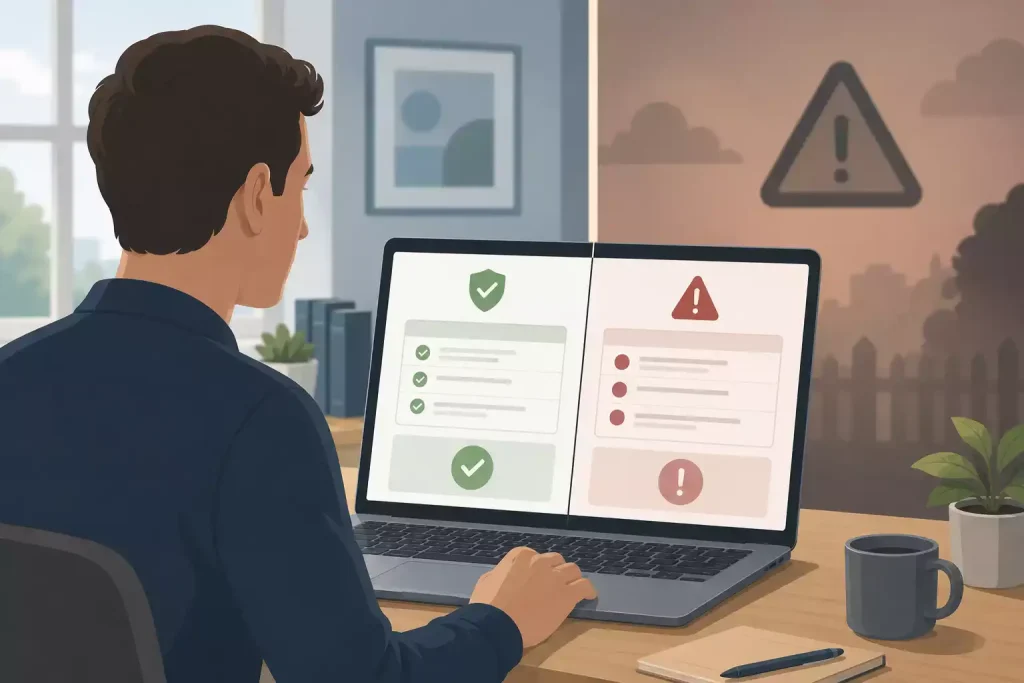
The decision path below is designed to keep the phrase in context. It is not a route to find or access gambling sites. It is a way to decide what kind of issue you are really facing.
- Ask whether the site claims to serve Great Britain. If it is taking or seeking customers in Great Britain, the Gambling Commission licence position matters. A foreign licence alone is not a substitute for the required GB permission.
- Check whether the business claims GB licensing. Do not rely on a logo in the footer. Use official register information to check the business name, trading name, domain and current licence status.
- Separate “outside GAMSTOP” from “safe”. Outside a self-exclusion scheme is not the same as safer, fairer, faster or easier. It may mean less relevant protection for a GB reader.
- Notice your own reason for looking. If you are searching because you have self-excluded, hit a bank block, reached a limit or feel pulled back into gambling, the safest next step is support, not another gambling account.
- Route the question to the right check. Licensing and domain checks belong in an official-register routine. Money questions belong in a payments and limits check. Pressure to gamble after self-exclusion belongs in a support route.
Common misunderstandings
| What someone might assume | A safer way to read it |
|---|---|
| “Not on GAMSTOP means it is a special category for UK players.” | It means the site is being described as outside the GB self-exclusion scheme. That creates a licensing and protection question. |
| “If it has another country’s licence, that is enough.” | A non-GB licence does not by itself allow service to consumers in Great Britain. The GB licence position needs checking. |
| “If the site accepts me, it must be allowed.” | Acceptance by a website is not proof of regulatory permission, fair terms or suitable protection. |
| “If I self-excluded, using a different site is just my choice.” | Self-exclusion is a protection measure. GAMSTOP users agree not to try to get around its mechanisms during the exclusion period. |
What to check next
If you are trying to understand a specific gambling business, start with official evidence. The licence and register checking guide explains what to compare before you share money or personal data. It covers business names, domains, current status, permitted activities, account-opening information, fees, bonus terms and customer-funds statements.
If your main worry is money, do not jump straight to a payment option. The payments, limits and customer-funds guide explains the credit-card rule, e-wallet boundary, financial limits, bank blocks and the fact that gambling balances are not protected like personal bank accounts.
If the phrase is attractive because you have blocked yourself, joined GAMSTOP or feel unable to stop, the more useful route is the self-exclusion and support guide. That route keeps the focus on protection and practical help rather than on finding a way round a block.
If the pull to gamble is the real issue, start with support and self-exclusion.
When to stop rather than keep checking
There are times when more checking is not the right next step. If you joined GAMSTOP, set a bank gambling block, used deposit limits or asked someone close to help you avoid gambling, searching for a site outside those controls can be a warning sign. The issue is no longer just whether a business has a licence or clear terms. It is whether gambling right now is likely to undo a protection you put in place for a reason.
A calm rule can help: if the next action would weaken a block, avoid a limit, ignore an exclusion or create pressure to chase losses, stop the gambling decision and switch to support. That is not a moral judgement. It is a practical way to avoid turning a risky moment into a larger financial or emotional problem.