

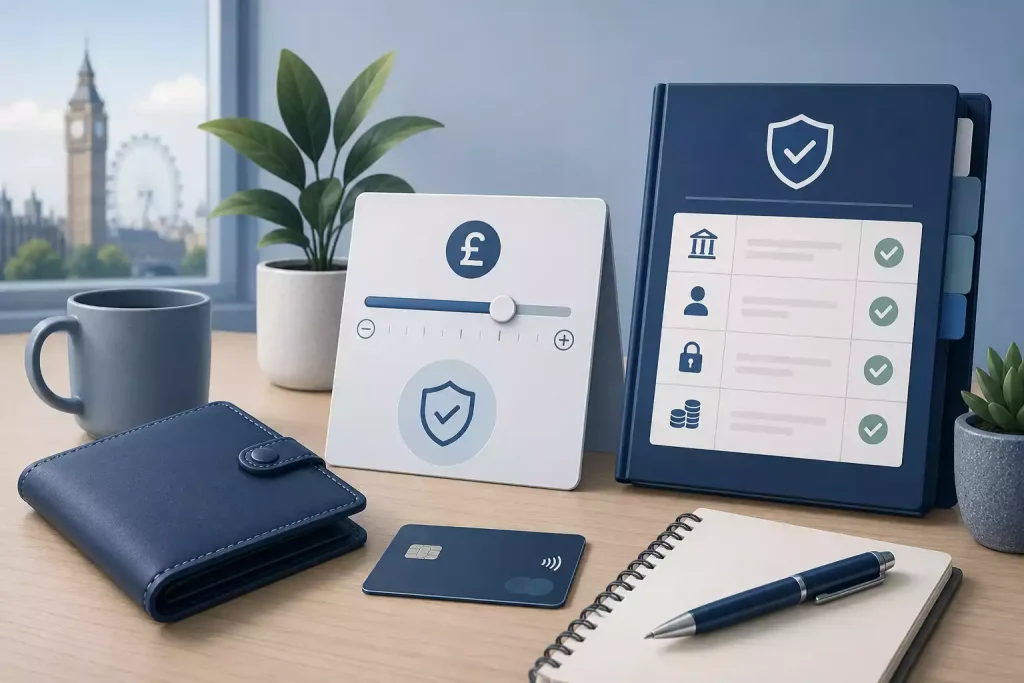
Money questions around online gambling are often framed as “which payment method works?” That is the wrong starting point, especially when a site is described as outside GAMSTOP. For a reader in Great Britain, the safer starting point is to understand the verified rules and risks: credit-card restrictions, e-wallet boundaries, customer-funds protection, financial limits and bank gambling blocks.
This guide does not list accepted payment methods, compare fees, discuss payout speeds or suggest ways to get around controls. It explains what to check before any deposit and why payment convenience should never be treated as a sign that a gambling business is suitable or safe.
Credit cards and e-wallets
Gambling with credit cards is banned for consumers in Great Britain. The Gambling Commission has also explained that the ban extends to credit-card funds used through e-wallet routes where those routes do not block the use of credit cards for gambling. The point of the rule is simple: gambling should not be funded through borrowed credit in a way that can deepen financial harm.
For a reader, the important conclusion is not to search for a different route. If a payment path appears to make credit-funded gambling possible, that should be treated as a warning sign, not a useful feature. A payment option being technically available on a website does not prove that it is appropriate, lawful for the consumer’s situation or consistent with GB protections.
Because e-wallet rules depend on whether credit-card funds are prevented from being used for gambling, it is not useful to make broad claims about every wallet, every site or every transaction. The practical check is to read the business’s payment terms and compare them with official rules. If the explanation is unclear, do not deposit.
Financial limits are protection tools, not obstacles
From 31 October 2025, GB gambling businesses must prompt customers to set a financial limit before the first deposit and make it easy to review and change that limit. Limits are often discussed as if they are a nuisance. In practice, they are a way to decide boundaries before emotion, losses or urgency take over.
A useful limit is set before gambling starts, not after chasing a loss. It should be based on money that can be lost without affecting rent, bills, food, debt repayments or family commitments. If the only way a gambling session feels possible is by lifting a limit, ignoring a limit or moving to a site without comparable controls, that is a sign to stop and reassess.
Limits are not a medical treatment and they do not remove gambling risk. They are one layer of control. For someone who has self-excluded or feels unable to stop, support guidance is more important than adjusting limits.
Money-risk comparison table
| Topic | What the verified rule or risk says | What the user can check | What must not be assumed |
|---|---|---|---|
| Credit cards | Gambling with credit cards is banned for consumers in Great Britain. | Check whether the payment route is trying to use credit-card funds or borrowed credit. | Do not assume a workaround is acceptable because a site appears to process it. |
| E-wallets | The credit-card ban extends to e-wallet routes that do not block credit-card funds for gambling. | Read the payment terms and the wallet’s gambling funding rules. | Do not assume every e-wallet transaction is treated the same way. |
| Financial limits | GB businesses must prompt customers to set a financial limit before first deposit and make review and alteration easy from 31 October 2025. | Check whether the account process asks for a limit and whether changes are easy to understand. | Do not assume the absence of a meaningful limit prompt is a consumer advantage. |
| Customer-funds protection level | Money staked or deposited with a gambling business is not protected by the Commission or government like a personal bank account. | Read the customer-funds statement and protection level before depositing. | Do not assume a gambling balance is protected if the business fails. |
| Bank gambling blocks | GamCare describes bank gambling blocks as free tools offered by most UK banks, with availability and effect depending on the bank. | Check your own bank’s gambling block information and how activation or cooling-off works. | Do not assume every gambling transaction will be stopped or that a block should be treated as something to defeat. |
Customer funds are not the same as bank savings
A gambling balance can feel like money sitting in an account, but it is not protected in the same way as money in a personal bank account. The Gambling Commission explains that money staked or deposited with a gambling business is not protected by the Commission or the government if the business fails. Gambling businesses must tell customers the level of customer-funds protection they provide.
That disclosure matters before deposit, not only after a problem. Look for the customer-funds statement and read it in plain language. Does it say funds are not protected? Does it describe a segregation arrangement? Does it explain the level of protection in a way you understand? If the statement is missing or vague, treat that as a serious information gap.
No wording can remove the risk that gambling money may be lost through play. Customer-funds protection is about what happens to money held by a business if the business fails. It is not a promise that stakes, winnings or withdrawals will always be safe in every circumstance.
Bank gambling blocks and support
Bank gambling blocks can add friction by blocking gambling-category transactions. GamCare describes them as free tools offered by most UK banks, although exact availability, coverage and cooling-off periods vary. They can be especially useful when someone wants a practical barrier between an urge to gamble and a quick payment.
A block is not a test to beat. If you have set one, or someone close to you has encouraged you to set one, the block is doing a protective job. Looking for another account, another payment route or another website changes the issue from payment convenience to harm prevention. In that situation, use support guidance rather than trying to complete a gambling transaction.
Bank blocks also do not replace official licence checks. A gambling business can still have unclear terms, weak customer-funds disclosure or a questionable GB licensing position. Money controls work best when combined with register checks, careful terms reading and honest limits on gambling behaviour.
How this connects to other checks
Payment information should be read alongside the business’s licence and account-opening information. The licence and register checklistexplains how to compare domain, trading name, status and customer information before depositing. If a withdrawal is delayed or identity documents are requested, the next issue is no longer just payment choice; the verification and complaints guide explains that route.
If payment questions are being driven by a desire to get around self-exclusion, a bank block or a limit, pause the transaction. The self-exclusion support guide focuses on safer next steps when gambling feels hard to control.